Artificial intelligence
All case studies
- Digital healthcare
Prescription and supply of medical aids
A web platform that follows the whole journey of a medical aid: from prescription to authorisation, from recurring deliveries to collection and sanitisation.
The starting point
Beds, wheelchairs and walkers, but also catheters, ostomy supplies and devices to be delivered every few months: the aids that health authorities provide to patients come from different suppliers, under tenders, contract codes and price lists. Every supply has its own rules: what can be authorised, at what price, how often it must be delivered and what happens when the service ends.
The previous portal depended on a single management system and left a lot of manual work: recalculating deliveries, exporting files, remembering to block future shipments when a patient cancelled. A new platform was needed, independent of the management system, that would hold all the rules together and follow the aid from start to finish.
The life cycle of an aid
- 1PrescriptionISO code, quantity, frequency, dates and attachments.
- 2AuthorisationItem, supplier and price allowed by the tender; the supplier receives it by email.
- 3Scheduled deliveriesCalculated from frequency and duration, grouped by patient and date.
- 4ShipmentOrders go to the supplier’s system; delivery notes come back to the case.
- 5CollectionFor reusable aids, linked to the previous delivery.
- 6SanitisationThe aid is treated and ready for a new delivery.
Reusable aids start the cycle again; for single-use items deliveries continue until the prescription ends or is cancelled.
Everyone sees their own part
Access is role-based: menus, data and actions depend on the role and on the state of the case. Permissions are granular and combine into profiles, and people working across several districts only see the cases they are responsible for.
Health authority operatorEnters patients and requests and follows their progress.
Prescribing doctorPrescribes starting from the ISO classification, with quantities and frequency.
Authorising doctorAuthorises by choosing the item, supplier and price allowed by the tender.
SupplierReceives authorisations and handles deliveries, collections and documents.
Back officeFollows day-to-day work, orders and shipments.
AdministratorConfigures users, roles, catalogues, tenders, prices and states.
From the ISO code to the right item
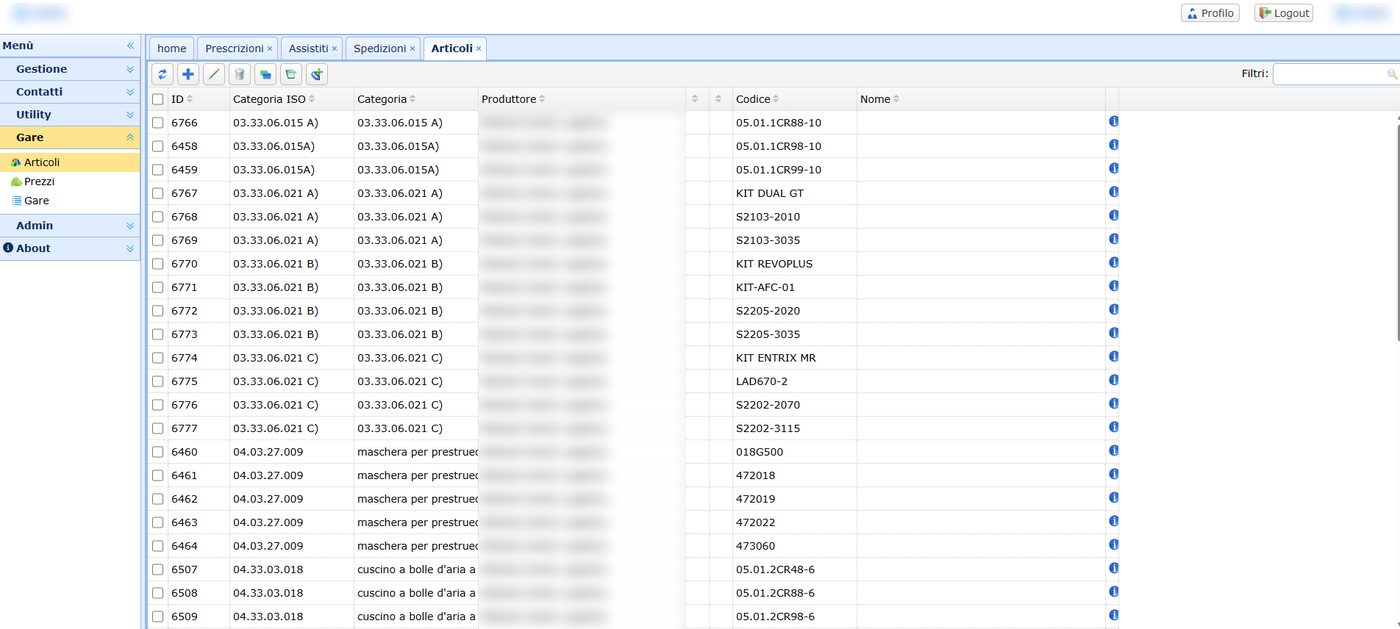
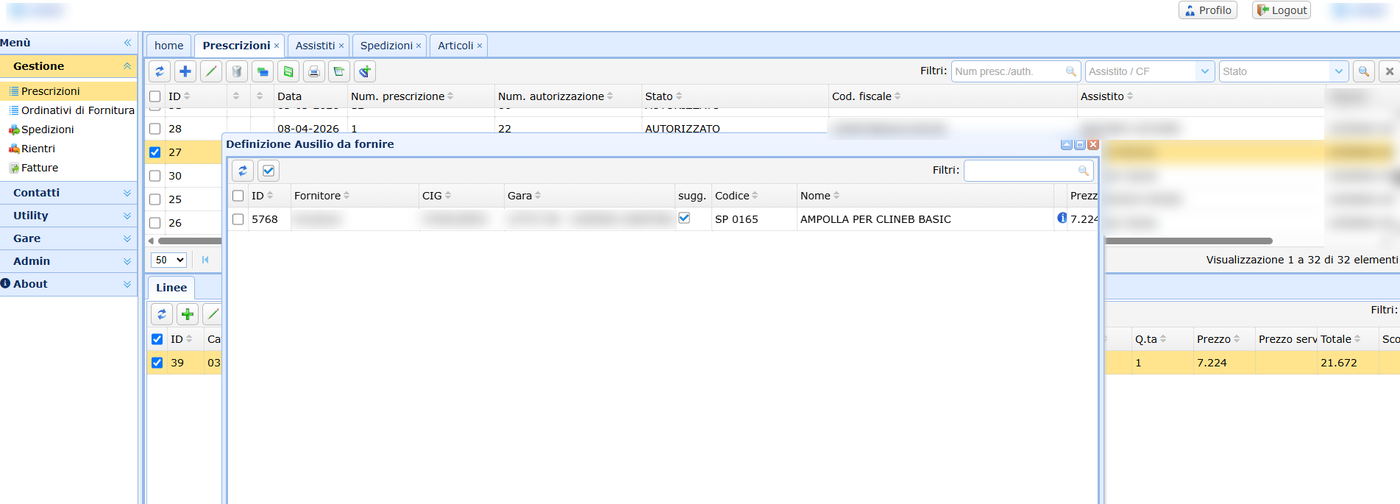
The prescription can stop at the ISO classification: one ISO code groups several equivalent items, even from different suppliers. The choice is completed at authorisation, and the platform only offers what that authority’s tender allows.
- ISO codethe patient’s need
- Tenderwhat is allowed for that authority
- Item and supplierwho can supply it
- Pricefrom the price list, per tender or set at authorisation
Deliveries calculate themselves
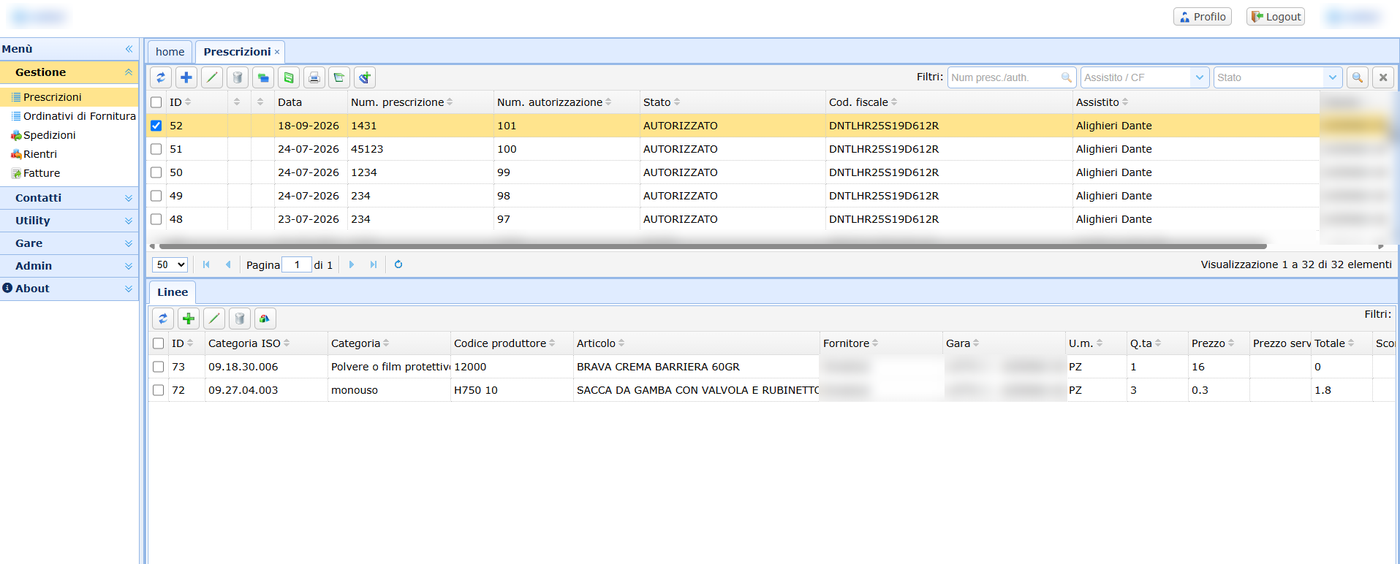
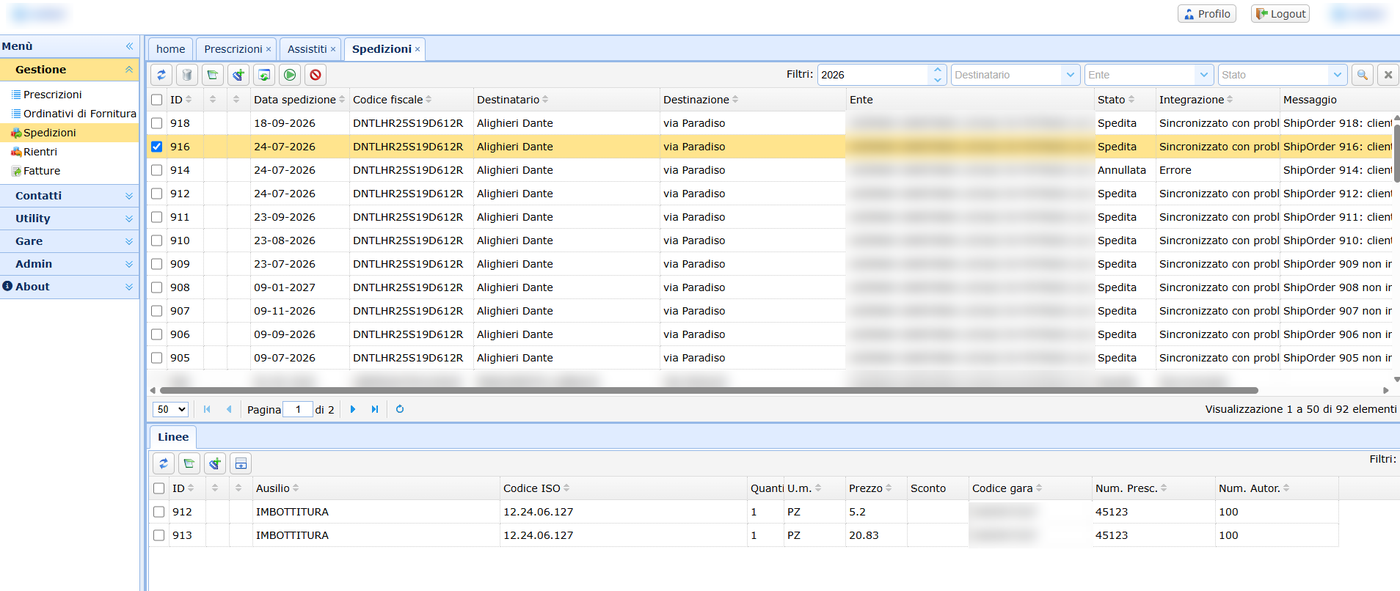
For single-use supplies the prescription states how much is needed per month and how often to deliver. The platform calculates the date and quantity of each shipment until the prescription or the tender ends, restarts from the last delivery made and merges into a single shipment those for the same patient, at the same address, on the same day.
If the patient suspends or cancels the service, shipments not yet sent are stopped. Rentals also follow a fixed schedule, until the equipment is collected.
Example: 30 catheters a month, delivered every 3 months
| Shipment | Quantity | Status |
|---|---|---|
| 15 January | 90 | Shipped |
| 15 April | 90 | Shipped |
| 15 July | 90 | Scheduled |
| 15 October | 90 | Suspended |
Example with made-up data: in September the patient suspends the service and the October delivery is stopped.
Documents, reports and configurable rules
Template-based documentsAuthorisations, summaries and collection documents are generated from templates with the case data.
Custom reportsReports defined by the administrator, with configurable fields and filters and Excel export.
States and transitionsStates and the transitions allowed to each role are configurable, with automatic actions attached.
ImportsItems, price lists, prices and patients are loaded from files, without re-entering them.
How it is built
The web interface and the services are separate. The front end takes care of the user experience; REST APIs in .NET 9 govern data, rules and case progress, on a PostgreSQL database. Access with ASP.NET Identity and JWT tokens, centralised logs with automatic error alerts, container-based deployment.
This separation makes it possible to evolve the interface and add new channels or integrations without rethinking the core of the platform.
What changes
- No dependency on a single management system: each supplier can connect their own.
- Recurring deliveries are no longer recalculated by hand, and suspensions and cancellations stop future shipments on their own.
- Only what the tender allows is authorised, at the agreed price.
- The aid is tracked along the whole cycle: delivery, collection, sanitisation, new delivery.
- The prescription is a set of structured data, ready to accept digital prescriptions in the future.
More case studies
Artificial intelligence
Asset inventory with image recognition
Read the case study
Artificial intelligence
Recognising industrial roofs from satellite imagery
Read the case studyWe are always curious to hear how your needs are changing
Half an hour on Teams: you tell us where you are heading, we tell you frankly whether and how we can be of use.